Monday, September 12, 2016

Ecuador Mission Discovery

It's been over 2.5 years since I came back from living in Ecuador. The 18 months I spent there transformed my understanding of my faith and a life called to social justice. I learned what it meant to truly be part of a community, to live and worship together, to share small moments in the every day. After completing my domestic missionary assignment in Alabama and finishing the Generation Transformation program, I knew I wanted to stay in touch with the global church, especially my friends and neighbors in Ecuador. 

At the beginning of last year, while completing my Master's degree in Social Work, a friend from Indiana Annual Conference contacted me because she had recently traveled to Ecuador and met Sara Flores, the missionary I worked closely with there. After some conversations with the conference, we decided a journey to Ecuador would further the global connection and mission of the church. The Ecuador Mission Discovery would be an opportunity for young people from the U.S. to meet young adults from Ecuador and build relationships while learning about the Methodist Church in a new context.


I was asked to co-lead this mission journey, which will take place in just a few months. We have been planning for the past year and have 8 young adults on the team. Our journey will begin in late December (after Christmas) and end the second week of January. While in Ecuador, we hope to invite several young Ecuadorians from local Methodist churches to join us in order to establish a connection between the two faith communities. The team will be working in various churches in the Sierra, or mountain region, doing some construction work, children's ministry, and exploration of the local culture with faith leaders.

The main focus of this trip is to foster intercultural dialogue and develop relationships between American and Ecuadorian Methodists. We believe that both nations and churches have much to learn from one another, and we hope to see God at work through the sharing of stories, experiences, and faith. Please pray for our team as we prepare for this incredible journey in la tierra de fuego


Sunday, September 4, 2016

Good Jobs Now

Well, it happened.

The day finally came. I finished my master's program and I am now an MSW! This past year has flown by, and I've been so blessed to have spent the last 12 months in the delightful city of Ann Arbor, Michigan, where the stores are hip, the coffee is freshly roasted, and the people are socially conscious. I am thankful for wonderful friends, connections with some hard-core social activists out there changing the world, a quality education, and my own personal success of toughing it up and going back to school. But, alas, my time in this cozy college town is coming to a close.

As a firm believer in living one's life in seasons, I am pleased to announce I have started a new (albeit short) season of my career: I've accepted a job as a Field Organizer with a non-profit organization called Good Jobs Now doing organizing around social justice issues in conjunction with the upcoming election. We are talking to residents of Detroit about five main issues: better jobs and a living wage, affordable child care, long-term care for seniors, racial justice, and immigration reform. We are also encouraging folks to register to vote, because this year's crucial election is only two months away! (So if you're not registered, go to your local Secretary of State office today).

Over the next few months, my team will be planning events locally in the city to build momentum around these issues and empower people to create changes in their own communities. Everyone has something to contribute: whether it's leadership skills, a knack for organization, relationships to others, speaking or writing, or just commitment of time. We know that when people come together to fight for improvements in their city, sparks will fly. Things will happen. I'm privileged to be a part of this critical work to make Detroit a better and more just place for everyone.

For today, I will leave you with this nugget of inspiration from Lilla Watson, a renowned indigenous Australian activist:

"If you have come to help me, you are wasting your time. But if you have come because your liberation is bound up with mine, then let us work together."

Sunday, January 3, 2016

Back to Academia

I'm doing it.

I'm getting a Master's degree.

I'm living the dream of a 20-something on a shoestring budget, sacrificing it all to feed her intellectual curiosity, hoping that one day she'll put the education to good use doing something worthwhile in the world. I'm working part-time and hanging out at the library on Saturday nights instead of socializing. Rushing around to the next meeting, class, or appointment like I haven't a moment to spare, because it's all good experience to put on my resume, you know.

Or maybe it's more than that.

Maybe I actually enjoy sitting in the classroom hour after hour because I find the idea of community organizing fascinating and see its potential to change the world. I soak in every word on the page and attend events on campus and try to get involved with local organizations working for justice. I listen to stories of my classmates and professors to learn about their experiences and dreams. Because I want to be a part of it. 

Returning to school after four years was not an easy decision to make. After graduating from Hope, I had made up my mind never to go back - I was done for good, forever. Grad school was just not for me. I could find a good job with my BSW or maybe live abroad for a while (I ended up doing just that, and it changed my life). However, near the end of those challenging and shaping years as a missionary, I heard God calling me to continue my studies. Steering me in a new direction. Beginning a new season of life.

I knew it would be difficult to get back into the "swing of things" as a student, learning to manage my time, focusing my mind to read for long hours, and of course, the dreaded group projects. I won't deny the first few weeks knocked the breath out of me, but I soon adjusted and developed a weekly rhythm. I even figured out the bus schedule.

Yes, there is lots and lots of reading. Papers and projects galore. But I find myself loving every minute of it. Every day brings with it experiences I never would have imagined. From planning a fundraising campaign for a local organization, to advocating for immigrants to naturalize, to exploring the injustice of gang violence in Central America, I couldn't be more excited about the work I'm doing. If that's not a sign that God has a plan and I'm in the right place, I don't know what is. I am forever grateful for this journey that I'm on.

For now, I'm going to keep focusing on school and gaining social work experience. In less than 8 months, I'll be an MSW! As I continue discerning what's next after school in August, your prayers would be greatly appreciated. Thanks for reading.


Sunday, September 20, 2015

Turning Over a New Leaf

Hello, there....it's been quite some time since I've written, yet much has happened in these past two months. As many of you already know, at the end of July I finished my term as a missionary with the United Methodist Church. It really is incredible how fast three years can go, and how much my perspective on faith and life has changed (for the better, I would say!). Thank you so much to everyone who has supported me throughout this amazing journey.


God definitely sent me to places I never would have imagined going on my own, and my eyes have been opened to both the stark contrasts in society and culture and the identical struggles all human beings face. Everyone has a desire to love and thrive, even though their definition of "the good life" might look completely different. Over the past three years, I have had the immense privilege of doing life with people from unique backgrounds, whose experiences I can never claim to fully understand. Yet in living in community with Ecuadorian farmers, in developing friendships with African American business owners, and in working with Alabamians dedicated to community development, I have gained awareness of myself, the injustices in the world today, and how God intends to use each one of us to create a more beautiful, peaceful society to live in.

My increased awareness and passion to address issues in the world like racism, poverty, and human trafficking has led me to seek further education. So, I'm getting my Master's in Social Work in Community Organizing at the University of Michigan in Ann Arbor. This year-long program will hopefully better prepare me for working in the non-profit world as a professional social worker and seeker of change. So far the MSW program has proved to be excellent in its focus on social justice and community engagement. I'm looking forward to what the next year will bring!

Not to brag, or anything, but it's pretty great here!


Needless to say, over the next 12 months, I won't be blogging regularly, although I might occasionally write about some of my experiences here (I already have several topics in mind, but grad school doesn't give you a lot of free time...). My hope is to create a new, better-looking blog at the completion of this year to continue writing about the intersection of faith, life, and social justice wherever I end up next! Be on the look out. Until then, I will leave you a quote to reflect on from the Magician's Nephew, which I just finished rereading. :)

“What you see and what you hear depends a great deal on where you are standing. It also depends on what sort of person you are.” - C.S. Lewis

Wednesday, July 15, 2015

Confidence

I remember that moment, about 20 years ago, when I first hiked myself up onto the brand new shiny two-wheeler, eyes sheer with excitement, feet anxiously grasping the pedals, hands a bit unsteady. Feeling my dad's hands over mine, I pushed off. And probably would have fallen, if it hadn't been for the confidence that I had in him. Over time the trust I had in my father to protect me became self-confidence, knowing that I could ride without falling off. As I became more practiced, I trusted myself to keep my balance while pedaling.  

Confidence is something that is built over time. It comes with discovering and embracing your true self, just as you were perfectly created in God, with an intentionality like none other. Confidence is a river consisting of vulnerability, genuineness, and a stubborn devotion to stand up for oneself. Three years ago, at the beginning of my missionary service, I can honestly say I felt God calling me, but wasn't entirely sure what, where, or with whom that calling meant for my life. Now, looking back on some of the wild, frustrating, hilarious, nerve-wracking, and sacred moments, I find myself confident in who I am and the woman God has called me to be.

These past few years comprised of some very "character-building" (read: tough) circumstances along with huge lifestyle changes. If not moving to the South where it's War Eagle (or Roll Tide), sweltering heat, and way too many fried everything's, y'all...then the cow's stomach soup, sleeping with 7 blankets, buying all my weekly groceries at the local market, and the daily mile walk to the highway to catch my bus in Ecuador. But in adapting to these new environments, I developed confidence in who I am. Thanks to many supportive friends and guiding mentors along the way, this confidence led the way to resilience and a deep sense of community.

God was at work the whole time, along this journey in missions, molding and shaping me to gain confidence....
  1. Confidence in public speaking, especially in churches
  2. Confidence in traveling alone, anywhere, anytime. As Ellie Roscher so elegantly puts it: "The fact that no travel situation henceforth will ever be daunting to me is a gift."
  3. Confidence in maintaining control of a room of energetic third graders
  4. Confidence in teaching in a second language
  5. Confidence in articulating my faith and passion for ending injustice
  6. Confidence in leading workshops and continuing conversations around important issues
  7. Confidence in planning and coordinating events
  8. Confidence in living in a town where I am the stranger, the newbie
  9. Confidence in advocating for others
  10. Confidence in being myself, and no one else
Building confidence in oneself and in one's faith is a lifelong process. I encourage you, reader, to take some time to recognize and rejoice in new confidences in your life, and anticipate those to come.

Thursday, April 23, 2015

Making Our Voices Heard

Last week in Montgomery, over 60 Alabamians gathered at the state house to rally around issues like payday lending, the housing shortage, raising the minimum wage, and lowering utility rates. We gathered to fight the injustice of our current system. We gathered to call for opportunities for everyone in Alabama to have access to the basic needs of food, shelter, clothing, and transportation. We gathered to make our voices heard. 


It was a gorgeous day in the capitol, as we listened to Kimble Forrister, Alabama Arise's director, share at a press conference about the need for new revenue to expand Medicaid. Later we had the opportunity to speak with several congressmen at a legislative luncheon.  I had my first experience with lobbying, which is really a fancy word for getting to know your legislator and telling her/him what it important to you. I decided to make my voice heard.


During my year at ARM, I have become more and more intrigued by the relationship between poverty and government, and the role we as citizens play in changing this dynamic. Participating in events like legislative day with Alabama Arise has reiterated in my mind the necessity of advocacy. We can (and still should) try to relieve the effects of poverty with direct services, but we must also rally for systemic change. Alabama Arise is a community of Alabamians that is committed to this organizing of the public in order to address poverty issues in our state. Arise is committed to making our voices heard.

Recently I have researched the affect predatory lending has on low-income individuals' situations. Racking up debts with multiple companies not only puts families in financial peril, but it can get them in trouble with the law, cause foreclosure on their home, or demand forfeiting of their only form of transportation (in the case of title loans). In the words of Representative Danny Garrett in a recent article, "A business model, built on an insurmountable interest rate so as to ensure repeat business - trapping a borrower on a debt treadmill, paying only interest for months and months, never touching the principal - is incomprehensible to me...and offends even the average sensibility." President Obama even visited Birmingham in March to make his voice heard on the seriousness of payday lending in Alabama.

Many of the low-income families we work with in rural areas of Alabama are especially affected by these issues because their towns have limited resources available and experience little or no economic growth. I have met individuals who are struggling to pay back debts from companies like Check-into-Cash and Always Money. These businesses promise quick and easy money, but more often than not exploit customers by charging exorbitant interest rates of up to 456% on a $500 loan. The high interest fees eat up a family's monthly income and leave no money left for food, mortgage payments, and doctor's visits. Are these voices being heard?


A month ago, I was invited by my mentor, who is a local pastor, to share about predatory lending at his church's local food pantry. As I shared about the dangers of this type of lending, I saw many nods and heard a few amens in the pews. Hearing those stories, it is clear that payday lending is not just an issue, but a social problem that affects real people. After my brief presentation, a woman came up to me and shared that she owed hundreds of dollars to companies like these. We talked for a bit...I didn't know a lot of options for her except to try to pay back the loans as fast as she could. And to make her voice heard.
So what is the next step? Borrowers don't have to face this alone. We can stand in solidarity with those who are suffering under this horribly oppressive system. Talk to your congressman. Send a personal letter about how you are affected by payday lending. Get people organized around an issue you care about.

Let's make our voices heard.

Sunday, March 15, 2015

Sharing Life With Our Neighbors and Friends

Two weeks ago, I had the privilege of speaking at Enterprise United Methodist Church for their Missions Conference. Here is an excerpt from the sermon I preached on John 15:9-17. The message shares about being friends with those we serve with, a topic that can be challenging when we are so used to going on mission trips thinking we come to save or "do for" others. Over the past few years, I have learned that engaging in missions isn't about what we accomplish, but the relationships that we form. It's realizing that those we come to "serve" have as much to give as we do, and learning to receive humbly and lovingly. 
 
     I moved to Alabama almost one year ago today. Having grown up in Indiana and attended college in Michigan, I had never experienced living in the rural South. For us outsiders, the South is known for being the land where country music, endearing accents, and sweet tea abound. But over the past year, I have found that Alabama is much more than this: it is a place of hospitality, community, and deep friendships. Today I’m going to tell you a story about a lady I met last summer, and how we became friends.

     When I began working with Alabama Rural Ministry, I went one day with our construction coordinator to visit Ms. Wood at her home outside of Auburn. That day we would be looking at some urgent repair needs in her home. We pulled up to her house, a small, one-story building with a decent sized yard. Ms. Wood and her son were waiting for us. They showed us into the small, cramped living room, kept warm with gas heaters. From the moment she opened the door, I knew Ms. Wood was one of those kind ladies that can bring a smile to anyone’s face when they’re having a bad day. We sat done and began to chat. With Ms. Wood, the connection was immediate and I felt that we had known each other for months.

     Later we walked into Ms. Wood’s bedroom to take some measurements, and I remember being shocked to see the damage in her floor. Termites had eaten away the wood and much of the walls. Ms. Wood could not even stay in her own bedroom at night – she was sleeping on the sofa. I was told that soon a group would be coming to put in new boards and laminate floor. There was certainly a lot of progress to be made. That day my heart went out to this kind woman. But I was struck by her positive attitude in her situation. 

     After a few minutes of conversation, it was time to go. Before we left, I remember that Ms. Wood stood up to pray with us. She shared with us a concern that her son was looking for work, and asked that we would pray for the family. I was touched by her genuine care and her openness in sharing her personal life with us. I asked her to pray for me as well. Ms. Wood said to me, “Oh Becky, I will. God is so faithful.” In talking with Ms. Wood, we had both allowed ourselves to be vulnerable in sharing life with each other. A friendship formed between us that was rooted in God's love.

 During my message, I spoke about 4 main principles of service:
1. Humility
2. Love
3. Vulnerability 
4. Community

Here are some key points:
      The example of servant-hood is crucial to the Christian lifestyle. Yet sometimes we view service as one-sided. When we go on mission trips, do we go thinking about the relationships we will build or the tasks we will accomplish? Do we only consider what we will give to others or realize that we may also receive? I remember distinctly the first mission trip I ever went on. A group from my college campus ministry went to Tijuana, Mexico, where we worked with a family and his church doing tasks ranging from feeding the homeless, to building a foundation to a house, to performing a Bible skit on the street. After the trip I remember feeling proud at the small tasks my team had completed. We had mixed cement. We had fed hungry people. We had made a difference! But it left me wondering, what did the church and Mexican family think when we left? Were they as excited as I was at the results? Did they expect us to keep in touch for years to come? I'm not so sure. 

      At times when we serve with good intentions, we can abuse the power it gives us to control others. Service then becomes exploitation and commercialization – for every thing we do, there is a second motive. This can take many forms: wanderlust, curiosity, pity, or even a genuine desire to help people. These motives are not necessarily bad, but can have negative effects on those we come to serve. Bob Lupton puts it this way: “I wonder if the reality of humanness will always make servant hood into lordship. It may be that there is no way to define service in order to keep from making it a system of control.” Thinking about this quote, I wonder…does service always have to perpetuate the sense that those coming into a community are superior to those who are already there? I would argue that it doesn’t. 

 To read the entire sermon, please go to www.arm-al.org/2015/03/sharing-life-with-our-neighbors-friends.  Thanks for reading!

Monday, February 9, 2015

A Community United

At the Martin Luther King, Jr. Community Worship Service this past Sunday, we were asked during the time of prayer to write down three dreams, prayers, or visions we had for the Tuskegee community. A few days later, I was touched to read the responses of individuals living in Tuskegee. What did people have to say about their community, its strengths, problems, and hope for growth? The word cloud below is a compilation of what people wrote:

What struck me most about these visions for Tuskegee was the desire for unity and community. Notice the large size of the words "people", "community", "together", and "unity" in the image. More people wrote about the need for unity among neighbors, peace in spite of our differences, and praying together across different church denominations than anything else.

Another large concern displayed was stopping the violence and neighborhood crime in Tuskegee. Many individuals spoke of the need for respect of all people and the importance of love and acceptance above all else. Reading these comments, I couldn't help but draw similarities to Martin Luther King, Jr.'s focus on justice and equality for all. Dr. King's message is as imperative today as it was 50 years ago: "The ultimate weakness of violence is that it is a descending spiral begetting the very thing it seeks to destroy. Instead of diminishing evil, it multiplies it."

 Among the various other concerns mentioned were better education, more activities for children, improved economic resources, the need for prayer, community involvement in social services, and job opportunities. Having living in Tuskegee myself for eight months, these dreams resonate with me. I cannot pretend to know firsthand the suffering many families living in poverty experience day-to-day. I have not been here long enough to fully understand the complexities of racial profiling and inequality. However, what I do know is the need for restoration in this community.

As ARM continues our commitment to love and serve in the Tuskegee community, we ask that you pray with us for the families living in this city and for the work that is ahead of us. Our dreams are big, and our vision is even bigger. One of our summer volunteers remembers, "...looking out the window at night and seeing all the potential that Tuskegee has to grow and be a wonderful place to live." Tuskegee, like many rural areas in Alabama, has plenty of potential for growth. We at ARM are hopeful for the future that God will bring for our neighbors and friends. And we are privileged to be a part of it.

Sunday, January 25, 2015

Working Toward A More Just Society

Growing up, I had always learned about the importance of Martin Luther King, Jr. in history class, but because it wasn't something I had experienced personally, it stopped there. With the facts. And statistics. Sure, I completely supported the movement and what it ultimately (though at a high price) accomplished for the equality of all races in this country. However, I had not truly seen firsthand the effects of racial inequality on a community.

Now working and living in Alabama (especially Tuskegee) has given me a new perspective on the civil rights movement and richness of African American history. I have met people who were kids when Tuskegee High School was integrated. I have spoken to pastors, educators, and local entrepreneurs about the changes that have taken place in this historic town since the 1960's, some successes, and others repercussions. 


In those days, Tuskegee was a thriving little city. The university, founded by Booker T. Washington in 1881, attracted top students from all over the country and provided invaluable resources, both academic and financial, to the community. Farmers and business owners, both black and white, prospered and life in the small rural city went on. Tuskegee became well known over the years for distinct personalities such as agricultural scientist George Washington Carver and the famed World War II Tuskegee Airmen. 


After having spent 8 months in Tuskegee, I have heard countless stories about how the city has evolved and the issues it currently faces. Years after integration in 1963 came a period of white flight. When families left, so did local businesses, jobs, and much potential for economic development. The standard of living decreased significantly for those who stayed behind. Whereas in 1960, the population of Tuskegee was quite diverse, it is now 95% African American. The population overall has decreased 20% since 2000. 


Now, 50 years after the Civil Rights Movement, we still have not achieved the goal of equal rights. Inequality, racism, and suffering still exist in our society. While all people have the right to vote, sadly we do not all have the right to a neighborhood safe from crime, a high quality education for our children, or a well-paying job. Poverty is the reality in the darkest corners of our country – whether Tuskegee or our own hometowns.

How is God calling us to address this? MLK Jr.’s answer is service and love. He claims, “Life’s most persistent and urgent question is: what are you doing for others?” Seeing the movie Selma, I was utterly moved by the way an entire nation came together to protest peacefully, despite the violence they faced from police - for a basic human right. The leaders of the movement didn’t just toss around ideas to achieve voting rights; they did something about it. How far will talking about social problems get us on the road to a more peaceful and just society? At what point will we choose to act?

I have been moved by the tireless dedication of some of the community’s leaders, specifically local pastors, to make Tuskegee a better place to live. Efforts like Stop the Violence Campaign, the Youth Safe Haven program, and ARM’s Sonshine Kids Day Camp have already played a huge part in providing enriching activities for kids. Last May, as part of the Summer Mission Camp experience, we interviewed some community members on the positive aspects of living in Tuskegee. One man said, “I personally am excited for the growth here in this community. I’m pro-Tuskegee.” 


How are you called to address crime, poverty, or racism in your community? Would you consider yourself “pro-(insert town here)”, or even pro-humanity, someone who would advocate for the rights of your people? In Psalm 82:3-4, the Lord calls us to “Defend the weak and the fatherless; uphold the cause of the poor and the oppressed. Rescue the weak and the needy; deliver them from the hand of the wicked.” The battle Martin Luther King, Jr. begun is not yet over. There is much work to be done, both here in the South and nation-wide. Let us prayerfully consider how to move toward a more just society.

Sunday, January 11, 2015

A Covenant Prayer for the New Year

As I walked into church the first Sunday of the new year, I was handed a card with the following words, labeled A Covenant Prayer by John Wesley, 1780. After reading it through together as a congregation, my pastor challenged us to reflect on how God is calling each of us to live out this prayer in 2015. I now share this reflection with you in hopes that you will consider what these words mean for your life.


I am no longer my own, but yours.
Lord, in this year, help me to focus less on myself and more on you. Remind me that I am a child of God, loved by you, and that you gave your life for my freedom from sin. Show me how to serve you in a way that honors you and values others.

Put me to doing, put me to suffering.
Redeemer, I pray that you would give me opportunities to act out against injustices, and to refuse to stand by and watch as your people hurt. Put me in challenging situations so that I may be humbled and grow in may faith in you. Let me experience the suffering that Christ underwent on the cross, so that I may know and understand more fully your love.

Let me be put to work for you or set aside for you, praised for you or criticized for you.
Use my talents and privilege, Lord, as you see fit. Mold me into the woman you created me to be. If I lose focus of you, set me on the right path, keep my eyes on Christ. Give me strength to stand up for you when others see trust in you as a weakness.  

Let me be full, let me be empty.
Creator, fill me with a deeper awareness of your love for all of humanity and creation, and a passion to bring your kingdom here on Earth. Empty me of resentment and anger toward those who have hurt me, and of apathy toward systemic oppression.  

Let me have all things, let me have nothing.
Sustainer, bless me with a strong body to serve, a heart that breaks for others, and a mind that conceives new ways of sharing your love. Yet let me be content with loving relationships instead of recognition, essentials instead of material luxury, and food on the table but not excess. 

I freely and fully surrender all things to your glory and service.
Do what you will with my life, God. Guide me in all my decisions, support me in those difficult hours, and rejoice with me in the beautiful moments.


And now God, my Creator, Redeemer, and Sustainer, you are mine, and I am yours.

So be it. 

Amen. 

Thursday, January 1, 2015

A Fair Price to Pay

I can remember when I was in high school, going to see the new Spider-man 3 movie (the 2007 version with Tobey Maguire and Kirsten Dunst). We were ecstatic, not only to see the movie, which we knew would rock our world, but more importantly because we would get to go to Taco Bell.

Why was this such an occasion? Because in our household, my mother had enacted a ban on Taco Bell, which had been in place for at least the past year. A ban, you say? What for? Taco Bell was not paying its tomato pickers a living wage. A boycott had been organized by the Coalition of Immokalee Workers, an advocacy group made up of Florida farm workers (mostly tomato farmers), and had received national attention.


At the time my brother and sister and I could not understand why anyone would want to boycott our favorite fast food place. But now, years wiser, I regret not having respected my mom's ideals. She truly understood the importance of valuing another person's life, and participating in non-violent protest as a way of fighting for what she knew was right. My mother was, and still is, a social activist, and I am proud to say that I am following in her footsteps. 

Many of you have probably heard of the concept of fair trade. Fair trade items are products that are produced through a sustainable line of companies that have passed certain regulations in regards to safe labor practices, providing workers with a living wage, and not using slave labor in the creation of their products. The goal of Fair Trade is to help producers achieve more humane conditions for workers, as well as environmental and economic sustainability. An overwhelming majority of big name brands and industries in the United States do not practice fair trade principles (and sadly, many individuals who are educated about corporate injustices remain indifferent).


For the past few years, as my consumer conscience has grown, and I am continually horrified by the inhumane practices of large corporations in this country, I admit that I have not spoken out enough. Even this meager post about fair trade is such a tiny step to demanding justice, to protesting for the fair treatment of hard-working people, whether American or of other nationalities, who every day are subjected to harsh conditions and wages too low to survive on. It is time to speak out for change. It is time to act.

A few weeks ago, during our quarterly meeting with the other Global Mission Fellows in the Generation Transformation Program, we discussed our responsibility to creation care and how we are called to act out against over-consumption and exploitation. This conversation left me pondering how I could use my small influence to improve the chances for a better, just life for others.

Because of this commitment, and my firm belief that God created each one of us to stand up for human rights, I have decided to take a very small step as my New Year's Resolution for 2015. My declaration is this (and I hope that you will hold me accountable to it):

This year, I resolve to not buy ANY chocolate or coffee that is not certified as Fair Trade.

We all vote with our dollars. My dollar, in this small way at least, will not support companies that exploit the vulnerable and the poor. I realize that in other ways, I will still inadvertently sustain the evil of slavery with my credit card, as I buy that shirt or cellphone. I hope that in the future I can say that I have actively sought out alternatives in these areas as well, but for now, this is my small step. I share my decision with you today, not to brag or boast, but because I wish to encourage you in doing the same, in your own small way. Because, as Mother Teresa famously said, "Not all of us can do great things. But we can do small things with great love."

Why decide to buy fair trade, when it's more expensive? I think it is a fair price to pay, for those who pick the coffee beans, for those who process the cocoa, for those who package it all into bags and bars to sell. Will you choose to pay a price that is fair?

Thursday, December 18, 2014

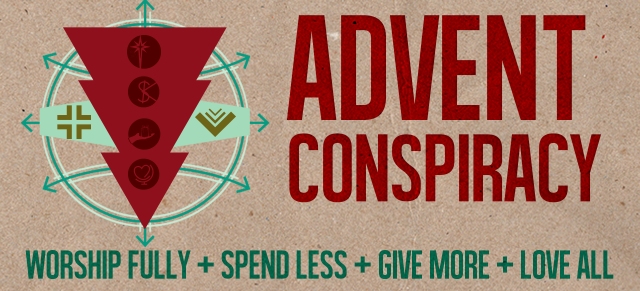
Advent Conspiracy

To me, the season of Advent in the church was always an exciting one, when we began to sing Christmas hymns, the traditional wreath appeared with its four small and one large candles, and the altar cloth changed to a deep, beautiful purple. At home, the flurry of constant baking begun, frequent (and secret) trips to the store were made, and we hung the lights outside our home. The world became a little bit brighter and warmer as the town lit up with color and holiday festivities. But for the most part, I don't think it truly captured the excitement and expectancy of waiting for the Savior.

This year at my church in Alabama, we are participating in a global movement called Advent Conspiracy. During the four weeks of Advent, the time of preparation leading up to the birth of Jesus on Christmas Day, we are focusing on four areas.

 AC_web1

1. Worshiping Fully
2. Spending Less
3. Giving More
4. Loving All

These might seem fairly basic, and they are. But how many of us actually commit to living out these four principles of our faith, especially during the most joyous season of the year? The goal of these few weeks of Advent is to capture the contagious joy of Christ's coming by looking beyond the glitter and candy to see the reason for the season.

In the beginning was the Word, and the Word was with God, and the Word was God.  The Word became flesh and made his dwelling among us. We have seen his glory, the glory of the one and only Son, who came from the Father, full of grace and truth.

Pastor Rusty used this example in his sermon two weeks ago: What if Mercedes-Benz told everyone at Christmas not to buy any cars from them, but to go and give their money away? How earth-shattering would that be? Think of the huge impact a decision like that could have on the global water crisis, world poverty, or homelessness? We all know that won't happen, but maybe it could happen, in our own family, church, or community.

It's like in Miracle on 34th Street, when Macy's decides to follow Santa's example and actually encourages customers to shop at another store with a better deal. If, for just a second, we could take the focus off ourselves and realize that WE are the answer to our prayers to end world hunger, the Ebola crisis, human trafficking, how powerful would that be? God has given many of us the resources. Now we must choose to use them for good.

Jesus was all about giving, not just his time and resources, but also sharing the Good News. God is love. The Savior has come. There is hope. If only you take up your cross and follow me. He never lost sight of the target - to transform lives with His love. This year I want to let go of the fake, shiny holiday Christmas has become. Instead of extravagant consumption, shouldn't it really be about extravagant love anyway?

With my co-conspirators at Cornerstone Church, I am conspiring to follow Jesus. We are making this Christmas different. Not only by focusing less on the material, but by giving more of myself to God. Worshiping fully. Taking time to adore the incredible God who chose to come to Earth as a baby in a manger. And loving everyone. Not just those around me, but neighbors and strangers and those who maybe don't have anymore to spend Christmas with.

As we wait in anticipation for the Redeemer of the world to come, let us shine his light in all the world, especially in those dark corners, just as Christ did.

May the joy of Christmas be with you throughout this season!


Sunday, December 7, 2014

Reblogged: Challenged Accepted

November and December have been busy months for us at ARM. This fall, I have attended several conferences and career fairs to let other know what we are up to in rural Alabama. I spoke to college students, youth ministers, and pastors at these various functions about the possibility of serving with Alabama Rural Ministry this coming summer, either as Summer Staff or a Mission Team. Although the bread and butter of our ministry takes place in the summer, fall and spring are very busy times for us for promoting our mission and service opportunities to churches in Alabama and throughout the Southeast.

At the National Youth Worker's Convention in Atlanta, we set up a mini-house to represent our work with families in the area of home repair. As a way to engage people walking through the exhibit hall, we set up the "Take a Swing!" hammer challenge: those who could drive a nail into the 2x4 in one swing won a prize. This proved to be a fun and original method of sharing about our work.

Lisa and Joe at Youth Specialties in Atlanta
At NEXT UMC, a creative conference for campus ministers and college students to "Dream, Go, and Do", I spent two days on my feet talking to folks about ARM's vision and ministry. During this weekend, I also had the wonderful opportunity to reconnect with some of my YAM (Young Adult Missionary) partners in mission.

With US-2's Connor and Stephanie at NEXT
Below I am re-blogging a post from my good friend Dave Johnson, who shares about our experience in Denver:

Challenge Accepted

Over November 7-9, 2014, a few of us Young Adult Missionaries traveled to Denver, CO for Imagine What’s NEXT. Through music, messages, conversations, and fun, this UMC gathering gave college students, and folks from agencies and organizations, time and space to connect, worship, and consider opportunities for service and vocation.

On Saturday evening, we were issued the $5 Challenge. As we departed for dinner and evening worship downtown, the organizers gave each participant $5 cash. We were not to keep this, but to use it to make the biggest impact possible in downtown Denver. They gave a number of ideas like buying a package of socks to give away, treating someone to dinner, or buying a bus pass for someone. They encouraged us to take pictures of our experiences and post them on social media with the hashtag “#5challenge.”

YAMS reunite in Denver!
As for the missionaries, the gears in our minds were spinning. Personally, I had just given a talk earlier in the day, and one of my points was an old standard at Church and Society: we often fail to make the distinction between acts of charity – temporary assistance for urgent needs – and justice – lasting transformation aimed at God’s Kingdom. God calls us to both through our lives of faith (Micah 6:8, Matt 23:23), but we often focus our ministries on charity. For us, the $5 Challenge was to think and act outside the box and do something a little closer to justice.

An idea budded and blossomed during break time: what if we bought sidewalk chalk and wrote messages of inspiration, encouragement, advocacy, and awareness on the streets of Denver? We ran with it. After dinner, we fortunately came upon an office supplies store 5 minutes before close (yes, we were those annoying customers). Six of us went in and spent $3 on 3 packs of chalk. We hit the streets.


Before our eyes, the results multiplied like fishes and loaves blessed by God. People read our notes as they walked by, some engaging us in conversation. Some people wanted to write words of wisdom and inspiration for themselves, so we gave them chalk to take with them on their own journeys. We tagged each of our notes “#NEXT14″ so that socially-networked passers-by might go online and see what else we were up to at the conference.


I like to think that people’s lives were changed, even just a little, by our “street tweets” – that someone would know that Christians carry messages of hope as well as challenge – that another might grow in their awareness that all people are valuable and treasured – that yet another would come to realize we were created to be alive and vital. A few strategic and beautiful words, bathed in the power of the Spirit, have the power to transform lives forever.

Some of the Pharisees in the crowd said to him, ‘Teacher, order your disciples to stop.’ He answered, ‘I tell you, if these were silent, the stones would shout out.’ –Luke 19:39-40


10325128_10202329577576577_4655090294365124033_nDave Johnson
General Board of Church and Society
Washington, DC
US-2, Class of 2013-2015
Advance #3021860

Sunday, November 23, 2014

Give Some Love on Giving Tuesday!

Hi friends,

    In just a few short weeks, Global Ministries will be participating in UMC #GivingTuesday. On December 2, 2014, all the donations you make to Global Ministries missionaries and Advance projects will be matched up to $1 million! This is an excellent opportunity to support the Methodist Church and further the work that organizations and projects are doing to transform lives through God's love around the world.


     With Christmas quickly approaching, we are all looking for that perfect gift for our family member or loved ones. Giving Tuesday is a way to extend the spirit of giving in the Advent season beyond just buying physical gifts.

     Donating to my organization, Alabama Rural Ministry, gives hope to families in Alabama whose houses need repaired. With your support, teams will work with these families to patch the roof, seal windows, or put up siding on their home. The cold winter no longer seems so hopeless.

    Donating to my missionary fund here will support current and future Global Mission Fellows (like me!) in the Generation Transformation program. You can help make it possible for a young adult to become a missionary and transform the world working with local churches, immigrants, campus ministry, children's programs, and more.

     Make your donation any time from 12:00AM to 11:59PM on December 2nd. You can click the picture at the top of my blog to support me, or go to www.umcmission.org to find a project. Watch this video to hear missionaries' stories about #GivingTuesday:


     Please pray that people all around the globe choose to support Global Ministries on December 2nd. The United Methodist Church needs your help, so that we can more effectively serve the Lord by serving others. This is your opportunity to connect with those doing mission - so go, and be the church!

Blessings,

Becky

Thursday, November 6, 2014

As the Potter Does

For five weeks now, I have been taking a beginner's pottery class. From the first moment I slapped the clay down onto the wheel, I knew it was something special. I had never really enjoyed art class in high school, and my drawing skills are about on par with a kindergartener. But pottery was different. The feeling of the clay in my hands, smoothing it, molding it into the shape that I wanted, mesmerized me.


I enjoy the methodical approach my instructor used to teach us the basics. First, center the clay on the wheel. Then, press it down, thumbs crossed, and poke the hole. Next is the "claw", as my instructor affectionately calls it. Then smoothing the lip, followed by a pull to make the clay rise. Every step has a technique, and only practice makes perfect. 

Molding the clay into the shape I want is harder than it looks. I crushed my share of pots before making a decent one. More often than not, I end up surprising myself with the end result, and a bowl appears where I intended a mug. What I lack is knowledge of how to control the clay. I'm learning how it feels, but I still don't understand how to make it do what I want.


Today as I sat at the wheel, trying hard to keep my arms on my legs, I was reminded of the passage in Jeremiah 18 that speaks of the potter. Jeremiah says, "So I went down to the potter's house, and I saw him working at the wheel. But the pot he was shaping from the clay was marred in his hands; so the potter formed it into another pot, shaping it as seemed best to him." (It's amazing to think that potters and wheels existed back then, isn't it??) The Lord replied, "O house of Israel, can I not do with you as this potter does? Like clay in the hand of the potter, so are you in my hand, O house of Israel."

 Just as my pots sometimes collapse or become deformed and I must either reshape the clay or start over, God has the authority to mold us as God chooses. He has given us the gift of free will, and we don't always follow the paths God has laid out for us. When we stray from God's intended path, or make a decision that goes against God's desires for us, God can either mold us into something new, or destroy us.


So, who is really in control? Us or God? Many of us, myself included, tend to be "control freaks". We don't want anyone else ordering us around or barging in to tell us how to live our lives. We have each day planned out, down to the hour. But here's the freaky thing: we're not really in control! God is. As much as we like to be captain of the ship, we need to hand over the wheel to the one who truly knows us. And let God do as the potter does, and shape us into who we are designed to be.

Sunday, October 19, 2014

Where Technology is Lacking

Recently I read a post on a friend's Facebook page:

My Childhood Was Like This:
I didn't have Blackberry, Wii, Playstation, or XBox.
I played hide-and-go seek, and football in the street.
The time for me to go back home was the hour it got dark,
And my mom didn't call my cellphone, but yelled: "Inside!"

Who do you think wrote this?

The answer is actually a friend of mine from rural Ecuador, but in many aspects my childhood was similar. Although when I was in middle school, we got a GameCube, growing up my brother and sister and I always played outside. We jumped on the trampoline, ran around the house shooting super-soakers at each other, and went on adventures in the woods.

I find it sad to see so many young kids these days standing in line with their parents, playing games on their iPad or phone, instead of inventing or imagining. Whatever happened to laundry basket "time machines", pirate battles in the barn, or picking raspberries in the backyard? The following video, titled "Can We Auto-Correct Humanity?" challenges the way we think about technology in today's society. Take a look:


I remember when I returned to the U.S. in January, being shocked to see iPads at the airport fast food restaurants to order food. I stood there for about 5 minutes, waiting to be helped, when a woman told me to type in my order on the screen. I followed her instructions to get my egg roll, while silently wondering if in 20 years the world would be run by robots.

Now there is nothing innately wrong with advancing technology. In fact, it helps our day-to-day tasks go much smoother and faster than 50 years ago. Examples: microwaves, Excel, graphing calculators, email. However, as Prince Ea articulates in the video above, we as a society are becoming more and more disconnected from real relationships. Instead of going to get coffee with a friend, we opt for Skype dates. Kids are staying inside playing video games rather than physically exert themselves playing basketball or tag.

While I admit that connecting with friends in the U.S. through Facebook was great while I lived abroad, and still allows me to communicate with people I know all over the world, chat windows and videos take away from the sense of community that comes with personal face-to-face interaction. God created us to be in relationship with one another: to help one another, to share with one another, to love one another.

So, I'm not necessarily propagating that everyone shut down their social media accounts. But what I am proposing is that each day, even for an hour, we take the time to unplug and have genuine conversations with real people. Without checking our phones every two minutes. Because who is more important than the person you're with at that moment?

Sunday, October 12, 2014

The Beauty of Change

As the season of fall begins to take shape in Alabama, I feel an indescribable joy fluttering inside myself. That simple contentment that comes from looking outside the window to see red, yellow, and brown leaves fluttering in the wind and to cozy up in my living room chair with a warm cup of pumpkin chai. I've been away from the U.S. so long I have almost forgotten the beauty of the changing seasons.

fall foliage contrast color

In Ecuador, there were two seasons: rainy and dry. You can probably guess what defined the two periods. During rainy season the days were wet and mucky, and it drizzled at least once a day. In the dry season, high winds swept through my little town, picking up dust and blasting cold into my apartment. There were many wonderful things about the climate in Ecuador, but I missed those special moments, like trees shedding their leaves or the first flowers peeking out from under the frost in spring.

 fall autumn leaves

A friend and mentor once told me: live your life in seasons. Don't worry so much about the distant future or try to plan your whole life out, but take it one season at a time. One season at a time. The metaphor stuck with me, and ever since that conversation in my last year of college, I have thought of my life in that way. I haven't chosen one career or scored the job that makes big bucks. But I have chosen a path for this season of my life. I chose to be a missionary, because that is what God called me to for now. I might not do it forever, in fact I really don't know what I'll be doing at this time next year, but God has a plan.

So while the cool winds blow through, and the temperature drops, I encourage you to embrace the change. Instead of complaining about the colder weather, see the beauty in it. As a wise man says in Ecclesiastes 3, "There is a time for everything and a season for every activity under heaven." 

Be blessed in this lovely fall season.

Sunday, October 5, 2014

Reblogged: Advocating for Alabamians

The following post is a blog I wrote for ARM's website a few days ago, sharing about my participation in the annual Alabama Arise meeting a week ago. 


Did you know?
  • Alabama is one of only 4 states with no state-level minimum wage?
Did you know?
  • Payday lenders in Alabama can charge up to 456% interest on loans?
Did you know?
  • Annual electricity costs in Alabama were the 2nd highest in the nation in 2011?
Did you know?
  • Alabama currently has a shortage of about 90,000 housing units?
At the Arise Citizens’ Policy Project meeting last Saturday in Montgomery, we voted to make “Dedicated Revenue for the Alabama Housing Trust Fund” a priority in legislation for 2015. Lobbyists will try to get a bill passed that will provide $20 million per year to create and rehabilitate homes for those in need. We also voted to support a bill that would cap payday loans at 36% statewide. These, among many other concerns, are issues that Alabama Arise addresses in their work with legislators, in order to improve the lives of low-income Alabamians.


Arise Citizens’ Policy Project is a coalition of non-profit organizations, churches, and individuals in Alabama that advocates for the poor by promoting legislation that benefits low-income families and individuals statewide. The issues that ACPP focuses on include improving public housing, reducing loan interest fees, raising the minimum wage, reducing utility costs, and prison reform. ACPP uses lobbyists to educate Senators and Representatives on these important issues that affect Alabamians. ACPP is a sister organization to Arise Alabama, an advocacy organization with the same goals and members.


Alabama Rural Ministry is proud to call itself a member of Alabama Arise. Much of our work with families living in rural areas addresses these same issues of poverty: lack of ideal housing and economic resources. It is our hope that through our work of repairing homes, building relationships, and providing children with safe and enriching educational opportunities, we can take an active role in combating poverty in Alabama.

It was such a privilege to attend the ACCP meeting and to witness the dedication of this organization to champion basic human rights for all Alabamians. I am inspired to do more in my community and my work here, so that together we might achieve this goal.

Tuesday, September 30, 2014

T-Shirts and To-Go Cups


A Challenging Look at Waste and Instant Gratification in America 

Today’s culture is one of to-go cups and T-shirts. We make cool T-shirts for every volunteer day, event, and mission trip that we go on or group that we are in. Stop the Violence campaign, National Honor Society, First Presbyterian Church, Methodist SWAG Day, Fill-in-the-Blank 5K Run, etc. We run to Starbucks to grab that latte, then trash the paper cup half an hour later. What's wrong with this story? you may ask.
 

Managing our Money

While T-shirts can be a great means of publicity, there is also a great deal of waste involved, financial and otherwise. First: think about all the money that goes into buying these shirts, largely for the same groups of people who received them last year, or maybe already have 25 T-shirts laying around in their closet at home. Couldn't that money go to support something bigger, a more valuable cause? Yet people will without a second thought write a check for $10 to get the official group T-shirt. It has become almost an unspoken expectation of every organization, college group, or community event in this country.

What to do with the leftovers?

Second: what about the material waste? And by that I mean, when the so-called event is over, where do all the extra T-shirts go? The organization, smart and prepared as it may be, has taken the initiative to order ahead and estimate the number of shirts that would be needed. No one would want to have to wait another week for that custom design. No one would be able to go without. No one could make do with the wrong size. No is just not an option here, in my society. Unfortunately, that “no one” means that organizations like mine, which are doing awesome work, have to spend extra money and prepare for those who we expect to serve with us. And when they don’t come…now, what do we do with all of these leftovers?


Undermining cultural values

Every year thousands of organizations are left with “extra” shirts that don't get used. Where do these shirts go? Of course it wouldn't be acceptable to make ourselves wear a shirt that was from last year (gasp!), so they either get thrown out, sent to Goodwill, or shipped to Africa. Kids in Rwanda may be wearing that tossed-out VBS shirt from 2010 that no one here wanted anymore. Do they care what the shirt says? Or even know? Probably not. But it gives me a weird, unsettled feeling. Like other people, who are worth less, are receiving our trash with eagerness. I can't count the number of times I saw people in Ecuador sporting U.S. Army hats, Chicago Bulls shirts, or New York sweatshirts. And they did not express shame or sadness for wearing these clothes. They were thankful to just have a shirt to wear, regardless of the lettering. Yet are we undermining the values of their culture by throwing our waste at them with a smile on our face? And it is really our role to define what needs a culture or community has? Here is a great article about how first-world charities with good intentions often do more harm than good.

Give it to me right now!

As for the coffee, we as a society have become obsessed with the idea of instant, to-go, or ready-made products. We just don’t have time to cook or prepare things ourselves. Now I’m talking about time, and how we often waste culture and relationships because we put work or other duties first. There is something special, in my mind, about sitting down to drink a cup of coffee in a real mug. Not only does it feel more genuine, but the fact that you took the time to brew that dark roast yourself, maybe with a friend, shows that you have taken a breather, time to reflect on life, if only for 20 minutes of your morning. So often we insist on having things right now. God’s timing doesn’t work that way last time I checked, and neither does the rest of the world.

Disposable things and people

And let’s not forget how many Styrofoam cups and plastic bags are already going into landfills daily in the U.S. alone. Every time I think about it, it scares me a little more. This summer, every youth group that came to Tuskegee on a mission trip used plastic ware all week. Why? They didn't want to wash all the dishes. We as a culture need to begin thinking long-term, permanent, renewable. It has become so easy to buy a product and throw it away when we are finished with it. This is also true in relationships. With many people moving across the country often for job opportunities and other reasons, friendships are hard to maintain. The divorce rate in our nation is now higher than ever: 53% of marriages now end in divorce. When did relationships become so disposable?
 

Conclusion

All of that being said, I do not think t-shirts are inherently a bad idea. At ARM, we save our extra shirts from every event to sell later in the year as an additional fundraiser for our ministry, which ultimately goes to help low-income families in Alabama. That intention in itself is a good thing. But we must be careful of allowing ourselves, especially as Christians, to be influenced by the general culture that rules our society. It may seem overwhelming trying to figure out how to take that small step in conserving resources, or taking the time to make things yourself, when they are so easily available elsewhere. Below I have compiled a few ideas to chew on, that I hope you will consider.   

How can I become a more socially conscious consumer?
  • If your organization frequently purchases T-shirts, try buying from a local company that makes their shirts here in the U.S., instead of possibly supporting child labor in China.
  • Think of ways to decrease your annual clothing consumption. Maybe this means making do with a smaller wardrobe, or buying a few essential pieces instead of splurging on those hot new heels or cute headband (yes, I am guilty of this, too).
  •  
What are some ways in which I can decrease my carbon footprint?
  • Increase purchase of reusable items, and try not to buy one-time use items like paper cups or plastic silverware.       
  • Decide to be okay with having less. Owning more junk means more stress anyway!

How can I think about others when I make daily decisions?
  • Read the book Everyday Justice by Julie Clawson. Understand your purchasing power. With great power comes great responsibility.
  • Everything we consume is made and processed by someone, somewhere. We have become so distanced from the actual hands that created the product. Take a minute to pray for the person and the work that contributed to your enjoyment of that new pair of headphones. 

For everyone who made it to the bottom of this post, thank you! I hope that amidst my ramblings, you were able to see the heart behind these seemingly radical ideas. As I continue to adjust to being back in the U.S., I am trying to challenge myself to enjoy some of the awesome privileges of living here, while at the same time not falling into complacency. I am trying my best to live a life of non-conformity and justice, and to think about how I can participate in bringing about God's kingdom for all people.